
Cartosat-3 satellite is a third-generation agile advanced satellite having high-resolution imaging capability.
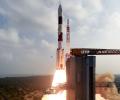
The launch is scheduled at 11.46 am on November 26, said the national space agency headquartered in Bengaluru.

The ISRO is strengthening 'eye in the sky', which helped the Indian army carry out surgical strikes last year, with the launch.

The space agency launched 104 satellites, breaking the previous record of 37 by Russia.

The launch is tentatively scheduled at 09.28 hrs IST on November 25, 2019 subject to weather conditions, ISRO said.

The mission objective is to ensure data continuity of ocean color and wind vector data to sustain the operational applications.

India on Wednesday successfully launched a record 104 satellites -- all but three of them foreign--from Sriharikota and put them into orbit in a single mission onboard its most dependable Polar rocket.

ISRO is developing a 100-kg "satellite bus" as demand has picked up for launching nano-satellites, chairman G Madhavan Nair said.

Other than the Cartosat-2 series satellite, the PSLV is carrying 29 nano satellites from 14 countries - Austria, Belgium, Chile, Czech Republic, Finland, France, Germany, Italy, Japan, Latvia, Lithuania, Slovakia, the United Kingdom and the United States of America besides a nano satellite from India.
The Indian Space Research Organisation will launch ten satellites, including eight from abroad, which will be carried by PSLV-C9, on April 28.The cluster of satellites to be lifted includes the Indian satellite Cartosat-2A, weighing 690 kg. The vehicle would also carry eight nano satellites of 16 to 27 kg from Canada, Netherlands, Denmark and Germany. Of the eight nano satellites, six are form a cluster called NLS-4. These satellites were built to test nano technoloy.

India performed yet another space feat on Wednesday when the Indian Space Research Organisation launched a record 104 satellites into orbit from Sriharikota, Andhra Pradesh, something no other country has done before.

The Indian space agency has already begun work on the third generation of the earth observation satellite -- the first of which will be ready by 2018 and boost the capability to generate digital maps.
Stage is set for the launch of PSLV-C9 from the Satish Dhawan Space Centre, Sriharikota. As many as ten satellites will be launched on Monday by the Indian Space Research Organisation, including country's latest remote sensing satellite and eight nano satellites.

The successful orbiting of the satellites by the Polar Satellite Launch Vehicle PSLV C-40 comes four months after the Indian space Research Organisation's mission to launch backup navigation spacecraft IRNSS-1H onboard PSLV-39 ended in a rare failure.

The space agency had earlier announced that the launch is tentatively scheduled at 09:28 hrs IST on November 25, subject to weather conditions.

India scripted history by successfully launching EMISAT, a military satellite, and 28 foreign nano satellites on-board its polar rocket from Sriharikota on Monday, in a complex mission which marked many a first for Indian Space Research Organisation.

ISRO's first mission in 2023 and SSLV's sequel saw a strange coincidence--it was launched at 9.18 am, the same time its predecessor lifted off from the Satish Dhawan Space Centre here on August 7, 2022 but could not deliver due to orbit anomaly and flight path deviation.

The Indian Space Research Organisation (ISRO) successfully launched its third and final developmental flight of Small Satellite Launch Vehicle here on Friday whose payloads can be used in applications like satellite-based surveillance, disaster and environmental monitoring, fire detection, volcanic activity among others.
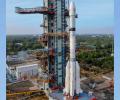
At 6.23 am on 29.1.2025, the 50.9 metre tall and weighing 420.7 ton Geosynchronous Satellite Launch Vehicle-F15 (GSLV-F15) is slated to blast off from the second launch pad carrying the 2,250 kg NVS-02 navigation satellite.
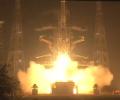
The Indian Space Research Organisation successfully launched its 100th mission on Wednesday, with a GSLV rocket carrying navigation satellite NVS-02.
India's Polar Satellite Launch vehicle-C16 rocket on Wednesday successfully launched into orbit the latest remote sensing satellite Resourcesat-2 that would study and help manage natural resources along with two nano satellites.

The announcement comes two days ahead of the proposed historic launch of the ISRO's 100th satellite along with 30 others in a single mission from Sriharikota.

Microsat-R, an imaging satellite, is meant for military purposes, but the ISRO did not give any details about it.

The countdown began at 6.27 am for the launch on board ISRO's third generation workhorse Polar Satellite Launch Vehicle, in its 47th flight, ISRO said.

CARTOSAT-3 is a third generation agile advanced satellite having high resolution imaging capability.

India's PSLV-C9 blasted off into space, carrying ten satellites including the country's latest remote sensing satellite CARTOSAT-2A, from Indian Space Research Ogranisation's Satish Dhawan Space Centre in Sriharikota on Monday.Scientists cheered as the Polar Satellite Launch Vehicle, in its thirteenth flight, soared into the clear sky in a perfect lift off at 9.23 am from the second launch pad.Besides the 690 kg CARTOSAT-2A, the PSLV is also carrying Indian Mini Satellite.

IIT-M plans to meet the next milestone of its earth satellite project by the end of this year.

ISRO has released the footage of the injection of PSLV-37 which launched a record 104 nano-satellites overseas customers into the orbit in blocks in a series of separations.

India is all set to script history by launching a record number of 22 satellites, including a number of micro and nano ones from foreign countries, in a single mission in May this year.

In the first dedicated mission of its commercial arm New Space India Limited (NSIL), the Indian Space Research Organisation on Sunday successfully launched Brazil's earth observation satellite Amazonia-1 and 18 other co-passengers, including five built by students, onboard a Polar rocket from the spaceport in Sriharikota.
'The solution is to replace, clean up, retest and proceed.' 'There is nothing to worry about if corrected.'

PSLV C-29 blasted off from the Satish Dhawan Space Centre, about 110 km from Chennai, at 6 pm and released the six satellites one by one into a 550 km circular orbit.

K Sivan has to hasten the effort to bring in private players into satellite and rocket building and replicate India's software success in aerospace.

The SSLV is designed to be affordable and amenable to industry production and aimed to function as a launch-on-demand platform for mini, micro or nano satellites.

On the morning of February 15, ISRO will hurl into space using the Polar Satellite Launch Vehicle three Indian satellites and 101 small foreign satellites. No other country has ever tried to hit a century in a single mission.

'To access our satellite, you don't need any IQ test, you don't need to write an examination.' 'You can be a Class 1 student, an engineering student, a 60-year-old person, anybody can access our satellite.'
India will boldly go to Venus for the first time and re-visit the Red Planet very soon.

The ISRO had earlier said Chandrayaan-2 will be launched in a window from January-February 16, 2019.Sources said it is expected by the middle of next month but no date has been finalised.

Skyroot Aerospace has become the first private company in India to give wings to the Indian space programme, after the sector was opened to private players by the Centre in 2020.
The 50-hour countdown for the launch of Indo-French climate monitoring satellite Megha-Tropiques and three other nano satellites on board PSLV-C18 on October 12 from the spaceport of Sriharikota is progressing well, the Indian Space Research Organisation said.
 © 2026 Rediff.com - Advertise with us - Disclaimer - Privacy Policy - Sitemap - Feedback - About us - Terms of use - Grievances